Saturday, October 31, 2009


Cyprus
"Siga, Siga" - Slowly, Slowly


From the sky Cyprus looks like a lotus leaf floating in the Azure blue Mediterranean basin. With fewer than 800,000 people it is smaller than San Francisco in size and population. When my plane lands in Larnaca airport the ground crew wheels in a staircase for us to disembark. I know instantly that I have arrived in a place where I can truly get away . From Banjul in The Gambia to Ulan Bator in Mongolia, to Thiruvananthapuram in India to Liberia in Costa Rica this test has always worked well. The reassuring sight of stairs being wheeled in means you are getting off in a place very different from most International business cities around the world which have increasingly started looking and feeling like each other – Chicago, Frankfurt, Shanghai, Dubai.
This has been a year of saying “Yes” for me; A year of saying yes to interesting experiences in life. So when a long time friend, Alka called me and told me that she was moving from Hong Kong to Cyprus and invited me to come visit, I told her, “Yes, of course”. From India to Hong Kong to Cyprus her house has been a haven and every time I step through the door I know I have come back home .


View Larger Map


Surrounded by Greece, Turkey, Syria, Lebanon, Israel, and Egypt, Cyprus is a testimony to the aphorism that Geography is Destiny. The island is divided into two uneasy, disconcerting parts – a Greek side and a Turkish side – that continue to sear the soul of a nation. Over the centuries invaders, settlers, and immigrants have come through – the Greeks, Romans, Byzantines, Lusignans, Genoese, Venetians, Ottomans, British, Turks, each leaving their stamp on Cyprus. Reading about Cyprus’ past and all the occupation evokes Churchill’s definition of history in my mind - “One damn thing after another”.


Cyprus has a love affair with love. Cypriots are quick to tell me that Aphrodite, the Greek Goddess of sexual love and beauty arose from the sea off the south coast of Cyprus. She was born out of the white foam produced by the severed genitals of Ouranos when they were thrown into the sea by his son Kronos. After emerging from the sea she entertained her lovers, leaving behind her an amorous scent that continues to intoxicate lovers. Richard the Lionheart married his wife Berengaria at Lemessos in the 12th century. The British continue to come here to get married in large numbers, resulting in a shortage of priests to officiate at the weddings.

I walk through downtown Lefkosia, the capital, through Ledra street to the Ledra street crossing. A pedestrian-only street it is a quaint medley of cafes, music stores, boutiques, and a monument to modern day commerce. At the end of Ledra street I walk across the “Green Line” past a sign that says “Last divided capital in the world” from the Republic of Cyprus side towards a sign that welcomes me to the “Turkish Republic of Northern Cyprus”. The very existence of this country I am now standing in defies logic; it is recognized by just one other country - Turkey.

In 1963, when the British were occupying Cyprus (why does this sound strangely familiar?), in response to communal disturbances between Greek and Turkish Cypriots the British military took a green pen and drew a line on the military map, creating the “Green Line” dividing Nicosia into a Turkish and Greek side. I suspect that when the British colonise a country and predictably there is discontent among the local population, they reach into a colonial handbook, thumb through the index for the entry that says “How to govern local population effectively”, and there find instructions from a British civil servant that say with clinical precision, “Take map, take green pen, draw a line across map, tell population to shift from one side of the line to another based on tribal, ethnic or religious lines”.

I grew up in India which was similarly divided into two countries by the British before splintering finally into three – India, Bangladesh, and Pakistan – a situation that continues to cause a simmer to this day. And in Palestine, Arabian Gulf, and much of North Africa, the British colonial pen across maps has reorganized and splintered populations across divides that has led to much strife.

In 1974 after military activity involving Greece and Turkey, Cyprus was divided into Greece and Turkish parts and the Green line extended across the entire island. As George Santayana once famously remarked, “Those who cannot remember the past are condemned to repeat it”. Another partition tragedy for humanity repeated as hundreds of ordinary Greek and Turkish Cypriots who did not have a choice in the matter had to abandon their homes, farms, and livelihood, uproot themselves, and to cross over to the other side of the Green line to start their lives over.

In 2008, abruptly the borders were opened by Raul Denktash the leader of the Turkish Cypriots. For 29 years the Green Line had divided a people from their friends and families. Similar to the fall of the Berlin wall, in emotional scenes, people from both sides crossed over to see for themselves what life was like on the other side, sometimes traveling back to homes and friends they had left behind.
Christopher McDougall | Born To Run


Two Fridays ago Chris McDougall, author of Born To Run spoke at Google. I got an opportunity to listen to his talk and go for a run with Chris.

As the event description said -
"Full of incredible characters, amazing athletic achievements, cutting-edge science, and, most of all, pure inspiration, Born to Run is an epic adventure that began with one simple question: Why does my foot hurt? In search of an answer, Christopher
McDougall sets off to find a tribe of the world's greatest distance runners and learn their secrets, and in the process shows us that everything we thought we knew about running is wrong. Isolated by the most savage terrain in North America, the reclusive Tarahumara Indians of Mexico's deadly Copper Canyons are custodians of a lost art. For centuries they have practiced techniques that allow them to run hundreds of miles without rest and chase down anything from a deer to an Olympic marathoner while enjoying every mile of it. Their superhuman
talent is matched by uncanny health and serenity, leaving the Tarahumara immune to the diseases and strife that plague modern existence. With the help of Caballo Blanco, a mysterious loner who lives among the tribe, the author was able not only to uncover the secrets of the Tarahumara but also to find his own inner ultra-athlete, as he trained for the challenge of a lifetime: a fifty-mile race through the heart of Tarahumara country pitting the tribe against an odd band of Americans, including a star ultramarathoner, a beautiful young surfer, and a barefoot wonder. With a sharp wit and wild exuberance,
McDougall takes us from the high-tech science labs at Harvard to the sun-baked valleys and freezing peaks across North America, where ever-growing numbers of ultrarunners are pushing their bodies to the limit, and, finally, to the climactic race in the Copper Canyons. Born to Run is that rare book that will not only engage your mind but inspire your body when you realize that the secret to happiness is right at your feet, and that you, indeed all of us, were born to run."

See Chris on The Daily Show - http://www.thedailyshow.com/watch/tue-august-18-2009/christopher-mcdougall

Last Sunday as I was running the Silicon Valley half marathon in San Jose, California another runner pulled up along me and he was running barefoot inspired by this story. He told me that ever since he started running barefoot he has been able to run longer and more easily.

Here is Chris's talk at Google on YouTube.


Friday, February 27, 2009


STATE OF THE ART
Geniuses At Play, On the Job

by David Pogue of NYT


David Pogue wrote an excellent article in the New York Times today about the hidden gems in Google labs. To read about iGoogle, Google Reader, Flu Trends, Google Maps, Gmail Labs, Translator, Goog-411, Google SMS, Google Sets, and Secrets of the Search Box, go here.....

Geniuses At Play, On the Job
by David Pogue of NYT

Saturday, November 08, 2008


No Limits


This morning I got the following invite from my tri club, the Silicon Valley Triathlon Club. Here is a perfect example of two people telling theselves "No Limits"


Our monthly club meeting is coming up next Monday night (November 10), at 7pm at Sports Basement Sunnyvale. Our featured speakers this month, Christine Thornbern and Ted Huang, are just back from the Beijing Olympics, where Christine raced for the US womens cycling team. Christine is a world class time trialist, (shes also an ex-collegiate runner -- should we see if she can swim?) who, among her many other racing accomplishments, also placed 4th at the 2004 Athen Olympics --> and to top it off she is a medical doctor specializing in rheumatology!! Do you feel inadequate yet -- read on! Her husband Ted has been a respected force on the Bay Area cycling racing scene for the past 15 years - coming in 12th overall in the San Francisco Grand Prix in 2003 - and has been to two previous Olympics in the sport of windsurfing (because cycling is his "other" sport!). Come and see their pictures from Beijing and hear their stories about racing at the worlds highest level.


(photo credits: www.emerys.com, www.llanellitriathlon.org.uk, www.socius.or.kr)

Sunday, July 13, 2008

In the End....

Browsing through a Lululemon store yesterday I came across this beautiful thought.

In the end what matters is
Did you live well?
Did you love well?
Did you let go?


Maarteen Troost | "Lost on Planet China: The Strange and True Story of One Man's Attempt to Understand the World's Most Mystifying Nation, or How He Became Comfortable Eating Live Squid"

Paul Theroux and Pico Iyer are among my most favorite travel writers on the planet. Having lived, worked or traveled in 41 countries, another perspective of places I have been to are very welcome. Here is another travel writer that I stumbled acorss recently (he is speaking at Google Mountain View later this week) that sounds very, very promising.
------
Lost on Planet China finds Troost dodging deadly drivers in Shanghai; eating Yak in Tibet; deciphering restaurant menus (offering local favorites such as Cattle Penis with Garlic); visiting with Chairman Mao (still dead, very orange); and hiking (with 80,000 other people) up Tai Shan, China's most revered mountain. But in addition to his trademark gonzo adventures, the book also delivers a telling look at a vast and complex country on the brink of transformation that will soon shape the way we all work, live, and think. As Troost shows, while we may be familiar with Yao Ming or dim sum or the cheap, plastic products that line the shelves of every store, the real China remains a world—indeed, a planet--unto itself.

Maarten Troost
brings China to life as you've never seen it before, and his insightful, rip-roaringly funny narrative proves that once again he is one of the most entertaining and insightful armchair travel companions around.


J. MAARTEN TROOST is the author of Getting Stoned with Savages and The Sex Lives of Cannibals. His essays have appeared in the Atlantic Monthly, the Washington Post, and the Prague Post. He spent two years in Kiribati in the Equatorial Pacific and upon his return was hired as a consultant by the World Bank. After several years in Fiji and Vanuatu, he recently relocated to the U.S. and now lives with his wife and two sons in California.


PS: Maarten's talk at Google can be found on YouTube on the Authors@Google channel. The talk is at this link.

Tuesday, November 20, 2007

Kiva - Changing the world one microloan at a time time.

Inspired by an article in the The San Francisco Chronicle about a former Googler and later by Bill Clinton's latest book "Giving", I came across an organization called Kiva (www.kiva.org). Based in San Francisco (of course) they use the power of the web to connect small entrepreneurs who need microloans with people around the world who want to make loans as small as $25. In their own words:

Kiva lets you connect with and loan money to unique small businesses in the developing world. By choosing a business on Kiva.org, you can "sponsor a business" and help the world's working poor make great strides towards economic independence. Throughout the course of the loan (usually 6-12 months), you can receive email journal updates from the business you've sponsored. As loans are repaid, you get your loan money back.

I gave it a whirl. It was a breeze and in a few minutes I felt like an International Banker having extended two tiny, tiny loans to two entrepreneurs in Cambodia and Kenya.

Meet my entrepreneurs.


Thursday, March 08, 2007


Blogger now allows users to type Hindi text in English and blogger transliterates it for you. So even though I can barely write in Hindi any more due to long years of disuse I can still speak it। So all I need to do is to hit a toggle button, write Hindi text in a rough English equivalent and Blogger transliterates for me. Very cool and nifty feature.

An ancient chant like

Asatoma Sat Gamaya
Tamasoma Jyotir Gamaya
Mrityoma Amritam Gamaya

when typed into blogger becomes

असतोमा सत गमय
तमासोमा ह्योतिर गमय
मृत्योमा अमृतं गमय

I await the explosion of Hindi blogs from what MTV calls the Hinglish generation.

Sunday, January 07, 2007


Dont Worry. Be Happy

Bobby McFerrin rode to fame in 1988 with his album Simple Pleasures, where he scored a chart-topping pop smash with "Don't Worry, Be Happy". But last week The Economist , yes that purveyor of the dismal science, joined the ranks of sappy happiness Gurus when it tried to analyze why people are not getting any happier even as the world economy is on its way to notching up its best decade ever. Market capitalism is doing its job well in terms of raising living standards but not necessarily making people happier which may be best left to saints and philosophers.

There are some fundamental problems according to The Economist. Capitalism is highly efficient in bringing to the masses what only a few elite enjoyed - cars, fashion goods, gourmet food, exotic vacations. But these luxuries soon become necessities. Once you are on the tiger you cannot dismount.

Second, there are a set of good and services that people believe will make them happy that are limited by necessity. These "positional goods" such as a a tony address or a fancy car or a top education lose their value if everyone has it. So a Harvard degree is no longer prized if everyone who applies is accepted into the program irrespective of the intrinsic value of a superior edification of the mind.

The race to be happy forces people to climb to the highest rung of the social ladder which forces others to climb harder and faster to keep up. What is the point?

As The Economist editorial concluded, "Capitalism can make you well off. And it also leaves you free to be as unhappy as you choose. To ask any more of it would be asking too much". I must admit that, John Micklethwait, the 16th editor of the August publication does have a sense of humor.


Wednesday, January 03, 2007


There were many holiday greetings and messages that arrived over the last few days. But this one from Louis a fellow burner and an annual visitor to and denizen of Black Rock City gently touched my heart.

Dear Members of the Tribe, the Clan, The Family, The Extended Family:

Happy Solstice!

This has been an amazing year !!!

Filled with wonder and discovery !!!

Filled with love and friendship !!!

Filled with conflict and the ability to sit with it !!

Filled with events that require more energy to negotiate and navigate !

Filled with new love and transformed love, growing friendships and continuing friendships and friendship that span almost an entire life ….

and for all the above I am grateful

I am connected to all of you as I am connected to all things

I wish you all safe journeys whilst you follow your path

I wish you love & light

I wish you joy & wonder

I wish eternal curiosity

I wish you gentleness and firmness in all things

I wish you intentionality & will

I wish you strength & courage

I wish you quietness & stillness

I wish a rich tapestry upon to weave your life story

I wish you a smorgasbord of experiential delights

I wish for you what you want for yourself…..

With love & gratitude

Louis

Sunday, December 11, 2005


Zambia - South Luangwa National Park

I am at the Mfuwe lodge set in the middle of the South Luangwa national park in Zambia. There are no fences around the lodge. The chalet I am staying in is on a oxbow lagoon. Just outside there is a herd of ten elephants noisily splashing around. A small family of Warthogs are getting out of the way with three tiny babies scampering behind their parents, unaware that they could be squished by the elephants. A wild buffalo got stuck in the mud earlier and the herd abandoned it to die haplessly. The guides told us that hyenas and lions would set upon the easy prey later that night and we would have to deal with the rotten smell of a carcass. But then these are the rules of the jungle. A mother baboon and its baby have occupied my patio and are looking intently through the screen mesh at what I am doing, cocking their head curiously at the unfamiliar strains of Bob Dylan from my laptop wailing,

“Windows were shakin' all night in my dreams
Everything was exactly the way that it seems
Woke up this morning and I looked at the same old page
Same ol' rat race
Life in the same ol' cage.”


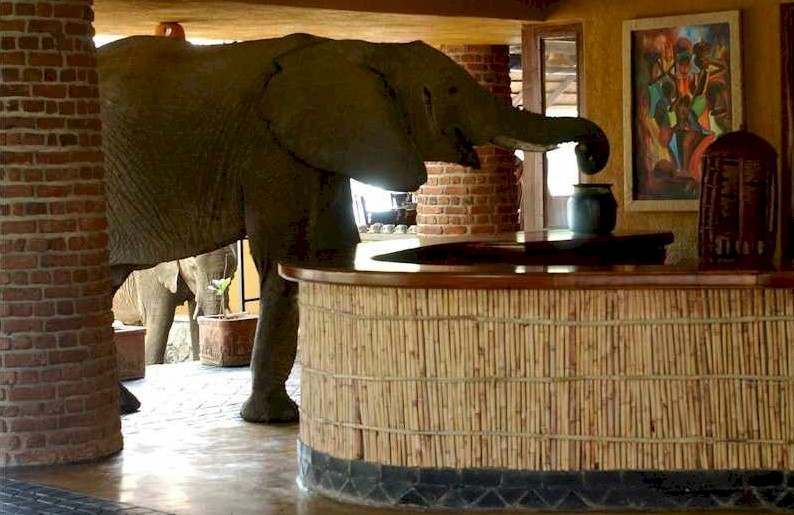
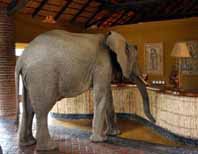
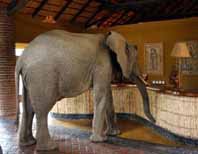
Assorted clusters of grazing herbivores - Impalas, Zebras, Waterbucks, Kudus, Pukus, Vervet monkeys, and Baboons are walking the dry lagoon bed to the wet patch in the middle having a drink or grazing on the few patches of green. The only part of the lagoon that has deep water has been colonized by a large group of hippos who have marginalized the crocodiles to the edge of the water. The hippos seem to fear no one and grunt threateningly most of the day and night. The animals walk freely around the lodge between the chalets. A certain herd of elephants is particularly fond of the mangoes from the mango tree in the courtyard next to the bar. It is an astonishing sight to see wild elephants walk through the building, stopping at the reception, sniffing at the strange smells from the vodka bottles in the bar before heading off to the tree. The lodge staff escort me between my chalet and the main lodge which reminds me that this is the wild, these animals roam free, and I am caged in my room or in my safari jeep.

Yesterday evening I saw a herds of elephants gather in a very organized fashion on the edge of the Luangwa river where they meet up every night. Once the herd was about 160 strong they crossed the river in several groups led by a senior matriarch. Upon crossing to the other side they dispersed into their respective family units to wreak havoc on the villages outside the park and eat up the mangoes and other crops the Chewa, Bemba, and Kunda tribes grow. Patson, our guide, tells us that they show up at his village every night and it is a complete nuisance. In the morning they make the trip back. They collect as a large group at a crossing point, make the crossing and then disperse again. Their social organization and intelligence demonstrated through this daily behavior is astonishing.

All this is a remarkable sight for a city dweller. To understand how to deal with wild animals if I encounter one on my way to grab dinner at the restaurant I refer my Lonely Planet guide to Southern Africa and it has this advice among much other useful information, "If a Rhino charges and you cant immediately climb a tree, then face the charge and step to one side at the last moment in bullfight style." The other guests in the lodge include a mining rights lawyer from Canada, a health care accountant from Belgium, and Brazilian couple who work in the Zambian copper mining industry. I spend the afternoon running little video clips in my head of Rhinos charging and how each one of them would do the clever sidestep maneuver as perfectly as the Lonely Planet guide suggests.

Wednesday, September 21, 2005


Iceland
Exotic Foods, Human Migration

Food is great way to experience any place you travel to. But Icelandic specialties will require Viking like courage and a suspension of your sense of smell. The most stomach churning is Hákarl – putrefied shark meat buried underground for upto six months. The stench can be unbearable – like ammonia – and the after taste requires to be washed down with Brennivín, sledgehammer schnapps made from potatoes and flavored with caraway. Someone long ago discovered that certain shark meat could not be eaten fresh and decided to bury it in sand, let it decompose, and try it again six months later. How human beings research these things is a great mystery to me. Then there is bl?ðmör, sheep’s blood pudding packed in suet and sewn up in the sheep’s stomach. And finally Svið, singed sheep’s head, sawn in two, boiled, and eaten fresh or pickled. The king of Icelandic gastronomic adventures is Sursadir hrutspungar, pickled Ram’s testicles. All of a sudden you feel grateful for the great invasion by Macdonalds, Pizza Hut, and Subway.

Human migration is always fascinating. Seeing people living in a context completely different from their usual one is always intriguing. As the editors of Lonely Planet are fond of saying, “Ever since our first, faltering, upright steps, humankind has traveled. Everywhere is migration, exploration, pursuit. Terrible things have been caused by this restlessness, but it is also the source of much that is extraordinary and wonderful.”

It is this great migration that brought the Celtics and Norse settlers including the Vikings to Iceland in the first place nearly 1400 years ago. And they continue to come from as far away as America, Mexico, Thailand, Pakistan, and Tibet.

Shalimar is a small restaurant in downtown Reykjavik run by a Pakistani couple. The three person staff consisted of an Icelandic waitress, Tse-Wang from Tibet, and a waitress presumably of North African origin. Tse-Wang is a fascinating case of this migration. Originally from the remote, landlocked, Himalayan country of Tibet he was driven out from his land and forced to live as a refugee in India. Now one of only four Tibetans in Iceland, he goes to college here, learns Icelandic, and tells me that he occasionally feels lonely and isolated from a larger Tibetan community. We banter about the Dalai Lama and the Kalachakra sermon, one of the most elaborate rituals of Mahayana Buddhism. The one ironic parallel is that he once lived in country that has the nickname of “roof of the world” and he now lives in another that also feels like the roof of the world given how close Iceland is to the North Pole. Similar fascinating tales pour out from the Polish, Portuguese, Chinese, Indians, Germans, and other nationalities I meet in Iceland. Each tale of migration unique in its own way – Kathleen the German nanny who has traveled through Mongolia, Febian the Frenchman who works on a chicken farm and wants to be a monk, Marco the Portuguese who along with his father and sister work on the Karunjukkar hydroelectric project.

The world is a breathtakingly big place. Iceland in particular is imbued with special magic. Pick up your bags and go.

Thursday, September 15, 2005


Iceland - When economics meets environment
Karahnjukar Hydro Electric Project

In Iceland it is easy to be environmentally correct. The country has a small population, large tracts of uninhabited land, almost no polluting industry, and the ability to live off geothermal and hydroelectric power without using fossil fuels except for automobiles. The lack of natural resources also means that there is very little to export except for products that come out of the ample surrounding ocean. You cant export hydro-electricity if you are an island nation. The next best option is to bring in industries that are thirsty for electricity. That has set economics and environmental issues on a collision course like everywhere else in the world. The Karanjukkar hydroelectric project is building a dam across two glacial rivers Jokulsao a Dal and Jukulsa i Fljotsdal flooding a remote part of the already remote Eastern Highlands. The power from the project will be used exclusively by the American aluminum company Alcoa in nearby Reydarfjordur creating jobs in an economically deprived area dependent mostly on fishing. The week before I got there angry environmentalists had camped out near the site and chained themselves to the construction equipment to protest the dam.

I cannot comment on the issues as I had not researched them. But to my untrained eye it looked like in the barren, desolate, cold, windswept, mountain side and valley that was being flooded there was really no life to protect – no trees, no animals, no plants, not even grass, or birds. The nearby town of Reydarfjordur, population 650, could do well with the 1000 new jobs expected to be created.

The dam is being constructed by the Italian company Impreglio and we are guests of some engineers working on the project. It is the fourth largest, earth fill dam in the world, possibly at the highest elevation, and definitely the one closest to the north pole. Nothing screams globalization like what I see here. The project site is one of the most remote, desolate, barren, and inhospitable work locations I have been to. All of a sudden it has created a new reverence inside of me every time I flick a light switch because I realize that someone gave a big chunk of their working life, living on a harsh project site to pipe electricity into my house. Toiling away on the project site are professionals from 43 countries. In the club house and dining halls I hear Icelandic, English, Italian, Chinese, Portuguese, Hindi, Urdu, Russian, Spanish, Arabic, French, Nepali, Malayalam. To my delight there is even a Malayalam speaking procurement specialist called Babu from the Indian town of Trissur where my parents live. We unleash verbal volleys in the machine gun style rapid fire exchange of our mother tongue. “Babu, ivade vannu yetra kallum aayi?”

During a visit to the restricted construction site I stand in awe outside the cavernous water intake tunnel. The tunnel will be submerged below the waters and carry massive quantities of water down a 500 foot drop to the bottom of the mountain that will power the giant turbines. Emerging out of the tunnel driving various kinds of earth moving equipment in an ant like fashion are workers of various nationalities, a lot of them Chinese. I am told that there are over 300 Chinese working on this project. Given the number of hydro-electric projects in China it is one of the best sources of skilled workers experienced in operating complex dam construction equipment such as tunnel boring machines. The Chinese ambassador to the region is visiting the project site to acknowledge their contribution and the Chinese flag is flying on the flag mast outside the dining hall. I had always imagined the Chinese economic power to mean simple things like the toys in Toy’R Us to be manufactured in Guangdong or the washing machines in Circuit City to come from Shenzhen. In more complex examples it meant to me that US Government bonds are being increasingly held by Chinese investors and that the Baltic Shipping Index is at an all time high because the Chinese are buying up all available shipping capacity. But this is stretching the limits of my imagination. Globalization is at work in remote eastern Iceland highlands unseen by the editors of The Economist and the Wall Street Journal. Chinese labor working for an Italian company is generating Icelandic electricity to fuel an American aluminum plant to boost the Icelandic economy. This would make the editor of Mother Jones spill his coffee in outrage.

To beat the loneliness and monotony of the project site the project team has found interesting deviations. The Indians, Pakistanis, and the Nepalese have a cricket club and I am invited to join a game. It is a surreal sight to be playing cricket at 10PM at night under the artic sun, in the shadow of a glacier, in cold windswept conditions, close to the artic circle. The founders of the game had intended the game to be played during the English summer wearing white flannels on a grassy field with a break for tea. Later they exported the game to their warm tropical colonies. But Wisden would never have thought that the sounds of “Howzaat” would be heard near the north pole.


Late at night, after a post-game chat session with some of the cricket players, I am trying to find my way to the guest rooms reserved for us in one of the living quarters, I stumble across a raging party. The gym where I had exercised earlier is now the scene of strobe lights and dance music. The people working on the project are kicking up a fuss on the dance floor. Two young men, who look to me of Latin American extraction and in their twenties stop to chat with me. They tell me that the party is hopping but there are not enough girls to dance with. Apparently, they had invited the “Sodexho girls” – the Icelandic girls who work for the catering and cleaning services contractor Sodexho on the project site. But most of them did not show up. I reassure them that some problems are universal. Their friends attending parties at the Copacabana in New York city or the Velvet Lounge in San Francisco would be bemoaning similar gender ratios at their parties. I encourage them to get back on the dance floor and work their salsa, mergengue magic.

(photo credit: Iceland Tourist Board, Linknot.com)

Wednesday, September 14, 2005


Iceland - Fire and Ice
Volcanoes, Glaciers, Farms

The power of nature and the magnificence of a land being actively shaped is most visible to me as I circle the island along the ring road, leaving from Reykjavik and driving along the south coast from west to east.

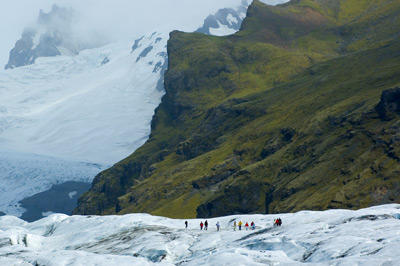
Driving past the moody volcano Hekla, ‘the hooded’, almost always shrouded in clouds and the horse-breeding area of Hella we are headed to Fellsmork. Sigurlaug “Silla” Gudmundsdottir, a friend of Pramod’s has invited us to stay in her summer house. Tucked away in beautiful settings around the island these are popular getaways for all Icelanders. Silla’s summer house is a cozy wooden cabin tucked into a fold on a mountain side. It is off the grid and has no electricity, running water, or telephone. The soft light of Icelandic candles adds to the soothing effect although the artic summer nights don’t need me to light them till close to midnight. Looking out of the bedroom window you can see the giant Myrdalsjokull, Iceland’s fourth largest icecap. Tongues of ice extend down from the glacier and the melt water streams converge into a roaring river to the right of the cabin. From the living room I look out to a vast glacial pain, flat as a pancake, fringed by a black sandy beach deposited by volcanic activity in the past. Just beyond sit the icy cold waters of the North Atlantic ocean with a jelly like constituency. And in the middle of the flat plains is a small mountain shaped like a loaf of bread sitting all by itself. It makes you scratch your head wondering what geological activity could have caused this formation. I conclude that one of the lesser gods must have been hurrying back from the grocery store when he dropped a loaf of bread which fell to the earth and turned to stone.

As we drive into south eastern Iceland the next day the most dominant geographic feature is the Vatnajokull icecap on the left. It is the third largest in the world after Antarctica and Greenland. Huge glacier tongues reach menacingly down the steep-sided valleys towards the sea. The road winds its way through a sandur - flat sandy plains of glacial deposits. The most dramatic of these is the Skeidararsandur that stretches some 25 miles between icecap and ocean from Nupustadur to Oraefi. The scene is one of a flat deposit of black volcanic gravel, sand, and silt, fierce winds, and fast flowing glacial rivers the color of beer. Travelers on bicycles pedal furiously across the bleak stretch to getaway before the winds whip up a stinging cloud of talcum powder like sand dust. The Sandurs are a result of Jokulhlaup – glacial floods. The Vatanajokull icecap actually sits on top of an active volcano, Grimsvatn, and acts as a tight lid. Occasionally Grimsvatn erupts in anger as it did in 1996 shooting a six mile column of steam. The ice began to melt creating a massive lake trapped under the icecap. Scientists waited with bated breath. Over a month after the eruption had started, the trapped lake lifted the entire icecap, peered out from below towards the faraway ocean, and drained in a massive Jokulhalup releasing 3000 billion cubic feet of water in just a few hours. A river, five times the volume of the Amazon, flowed towards the Atlantic ocean dragging with it icebergs the size of multi-storey buildings, snapping bridges and roads along the way like matchsticks. It was Iceland’s natural fire and ice show at its best.

Things are a lot mellow now as we approach a bend in the ring road and see luminous blue icebergs floating in a lake right next to the highway in Jokulsarlon (Glacial River Lagoon). The lagoon is a crammed with icebergs with interesting shapes creating an arctic scene. It is a breathtaking scene that has also drawn James Bond to film “Die Another Day” and Angelina Jolie to film, “Lara Croft: Tomb Raider”.

Iceland can also present a stark scene with almost no trees anywhere. It is so bereft of trees that when I drive past Hallormsstadur what I see is a small collection of native trees – dwarf birch, mountain ash, and Alaskan poplars - reminding me of the wooded area behind my old house in North Carolina. I am told that this is the Icelandic forest. Icelanders flock here over the weekends, to camp in a quiet forest and throw raucous parties in the night.


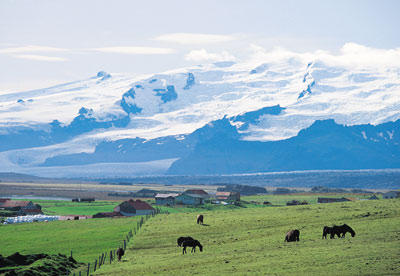
The best person to tell me about Iceland’s lack of trees is Haraldour “Hallie” Antonson. Hallie is Pramod’s landlord and neighbor who has invited us to visit his farm house in Lambleikstadir near Hopn. He used to work in a soil conservation and tree planting program for the forestry commission and now spends his retired life during the summer months on the farm raising horses. Hallie walks me through his farm with his sheep dog Loki sniffing my travel worn shoes picking up foreign scents. The horses look at us briefly with a snobbish half-interest before going back to their grazing. The grandkids Karin, Byarki, and Egitl are building a house and campfire under the watchful eye of their German nanny Kathleen who speaks no Icelandic. But that is no hurdle for the kids who communicate naturally and un-selfconsciously as children do and get what they want. Kathleen, herself is a well worn traveler, who although in her 20s tells me tales from Mongolia, the Trans-Siberian express, riding in army trucks across Afghanistan, and biking down the ring road of Iceland.

The Sagas record that when Iceland was discovered it was covered by trees from seas to the mountains. If that were indeed true the early inhabitants did a pretty efficient job cutting down the trees for fuel and allowing their sheep to finish up by devouring young shoots. Hallie explains to me that sheep are super efficient destroyers of vegetation, if grazing is not managed, chewing plants and young shoots down to the roots and leaving the underlying soil vulnerable to erosion by water and fierce winds. Once the top soil is blown away it is almost impossible to restart vegetation. The reforestation program has been quite successful and new clumps of trees are beginning to dot the country. I explain to Hallie proudly that my grandfather was a rice farmer in a village called Chittliencherri in Southern India although his total landholding was the size of a couple of football fields. I ask Hallie about the size of his farm and he waves to the distance towards the Vatanajokull icecap where his farm ends. I had read that the lack of humidity in the Icelandic air makes everything much closer than it is. I realize with a gasp that Hallie’s farm which has four adults and three children is about the size of my home village Chittilencherri itself where 20,000 people live and farm. Standing on a mound we spot a group of sheep grazing in the distance that had strayed over from the neighboring farm. “Woof, woof “ barks Hallie pointing them out to Loki. “Woof, woof” responds Loki excitedly as he spots the sheep. Curling himself into a tight ball, he explodes into a charging, sprint towards the sheep. From a mile away they smell danger and scatter clumsily in different directions towards their farm in a fine demonstration of sheep dog skills. “Yau (yes), Yau”, Hallie,acknowledges proudly.

(Photo credits: Iceland Tourism Board)

Tuesday, September 13, 2005


Iceland - Sticker stock in Reykjavik and touring the Golden Circle.

Why everything is so expensive and how Icelanders manage to live here is not so clear. Of course island nations from Tahiti to Iceland have to deal with importing most everything from somewhere else. Other than fishing, some cattle raising, and plenty of energy from geothermal and hydroelectric sources Iceland has to depend on other countries from produce to cars and computers. Add a hefty 25% tax on goods and cost of living can be frightfully high stripping clean your precious US dollar travel budget.

My simple comparative economic analysis makes it all very clear. A no frills meal at Shalimar, a down to earth, Indian-Pakistani restaurant costs $100 for three. A similar dinner at the Shalimar in downtown San Francisco (same name, similar food, similar ambience, similar Pakistani owners) would cost $45. As the average price for a gallon of gas in the US crossed $2.20 it set off a flurry of angst ridden calls on radio talk shows. In Iceland I pumped gas for $6.43 a gallon. I checked out the most trusted of benchmarks that The Economist uses everywhere in the world – the health-unconscious Big Mac. The MacDonald’s in Palo Alto, California serves it up for $2.90. The MacDonald’s in Aukereryi, Iceland will hit you for $7.40.

So how do Icelanders cope on what looks to me like modest salaries I ask many people. The explanations I get leave me unconvinced. Many people live off two or more jobs. Living off credit cars and other forms of debt are common. That sounds like a reasonable short term solution. I am baffled about how this model has been sustained over the years.

The economy is tiny, compact, and quaint. The Iceland Stock Exchange trades 15 stocks, Market capitalization is at $22 billion thanks to a threefold rise in three years making it one of the hottest but mite-sized markets in Europe. The market rose a stunning 58% in 2004 alone. Nevertheless the market is thin with seven companies accounting for 71% of the total equity trading last year. The big three – Iceland’s three largest banks – alone have assets three times the GDP of the country and account for two-thirds of market capitalization.

What makes Iceland really, really interesting lies outside Reykjavik and its stock exchange. Pramod and Aroma, an Indian family living in Iceland indulge me by driving full circle around the island over a few days. I have never met them before and only had a few email exchanges after an introduction through a mutual acquaintance. Their hospitality for a complete stranger leaves me very touched. Their Icelandic friends in turn extend their hospitality by inviting us to stay in their homes, summer houses, farms, and guest rooms. Add to that the delight of a precocious five year old called Vibhu with intelligent questions and jokes delivered fluently in three languages – English, Malayalam, and Icelandic – and I had the trip of a lifetime. By the end I am chanting nursery rhymes in Icelandic, “Ullen, Thullen, Thol, Pike, Pane, Gol…..”

Iceland and Greenland urgently require a name swap. Iceland is actually quite green with endless rolling hills and green plains. Greenland, as I flew over it, looked formidable and forbidden with its huge desolate snow plain, scarred by mighty glaciers, massive icebergs creaking in the ocean, and soaring snow covered peaks. Although massive compared to Iceland the frozen plains of Greenland are a land of snow and silence and home to only 56,000 people and some polar bears, reindeer, and artic foxes.

Iceland also needs a giant construction sign over it. Sitting on top of active volcanoes and geothermal hotspots, you almost want to check the weather report before venturing out in case your day is interrupted by rattling earth, stampeding lava, or showering ash. As recent as 1963 a volcano erupted in the waters off Iceland. TV cameras hovered overhead and people around the globe watched in fascination on television the creation of a brand new island called Surtsey named after the Norse God Surtur who has the duty of setting fire to the earth at the end of the world.

Vestmannaeyjar (the Westman Islands) is one of the friendliest places in Iceland due to its relative isolation; Vestmanaeyjar was hosting an annual festival the weekend I arrived in Iceland. The festival sounded like a cross between Burning Man and the Bonnaroo festival. One night in 1973, a volcano erupted on the island spewing 30 million tones of lava over the town of Heimaey. TV viewers around the world watched the chillingly compelling and morbidly fascinating footage of residents fleeing their homes against a background of angry, boiling lava.

Most visitors to Iceland will experience its natural beauty as they drive around the golden circle close to Reykjavik. Just outside the airport the Hitaveita Sudurnesja geothermal plant uses superheated water pulled out from a over a mile below to produce electricity. The water is then piped into one of Iceland’s most visited attractions – The Blue Lagoon. Throngs of tourists bob around in the waters wearing masks of silica. The eponymous lake gets its name because of its surreal pearly blue glow under a hazy, steamy pall created by the steam rising from the piping hot water into the frigid air. At Thingvellir, you can see the 2.5 mile gap between the European and North America tectonic plates. The gap is widening by about two inches each year as America and Europe drift away from each other tearing apart the heart of Iceland. Pingvellir is also the site of the Althingi, the Viking parliament from 930 AD. The Vikings had a fairly, sophisticated parliamentary process for far-flung settlements that gathered here once a year to settle disputes and ratify laws. Even as the rest of us were still clubbing each other to death over issues like “your cow strayed into my pasture”.

A little beyond is the community of Geyser with the original Geysir discovered in 1294 that can spout scalding hot water 250 feet. Every other Geysir in the world derives its name from the original one here. Alas, Geysir stopped spouting in the 60s after being bunged in by rock, dirt, and soap tossed in by tourists trying to set it off. Now it only comes to life after an earthquake and so the last spout off was in 2000. But right next to it is the little cousin Strokkur (the churn) which erupts faithfully every 10 minutes as the geothermally superheated water and steam trapped in a fissure and seeking an escape blasts out the cooler water on top shooting up about a 100 feet. The Golden Circle rounds off at Gullfoss, Iceland’s most photographed waterfall, where the Hvitao (white) river tumbles 90 feet into a steep canyon kicking up a fuss and lots of spray creating shimmering rainbows over the gorge. The falls almost disappeared in the 1920s when the Government accepted a proposal from investors to dam the river for a hydroelectric project. The landowner Tomas Tomasson refused to sell and his daughter Sigridur Tomasdottir walked all the way to the capital in protest and threatened to throw herself into the falls. The Government ignored her anyway and approved the project. Sigridour stayed dry on the side of the waterfall. The investors defaulted on the lease. The Government canceled the project. Where environmental activism did not triumph basic economics did – no pay, no way. The laws of economics are immutable even in Iceland, even if they are inconvenient.

Monday, September 12, 2005


Iceland – Small place, Big Soul

Iceland is a small pace with a big soul. It is designed to startle you all the time. Driving out of Keflavik airport you pass a barren lava field that looks like a lunar landscape. Steam hisses out from geothermal springs underground reminding you that this is a land forged literally out of fire and ice. It is also frightfully expensive and can suck up your devalued dollars out of your wallet like an industrial vacuum cleaner. A 20 minute cab ride from the airport to the center of Reykjavik the capital will set you back $150. Dotted by steaming lava fields, icecaps, glaciers, hot pools, and geysers, the Icelandic landscape has an elemental rawness that makes you aware of the awesome creative power of the earth. Reykjavik, the northernmost capital in the world has a raging nightlife earning it the title of the coolest capital of Europe

Iceland has always held a fascination for me. Tom Clynes had written in the National Geographic about a dramatically lit, ghost-brown place, peppered with lava flows and geysers, populated by farmer-poets and fair beauties. He called it the last great wilderness in Europe with no castles or palaces.

But Icelanders have a strong sense of history and myth woven through the Icelandic sagas. Written by anonymous authors between 1200 and 1400AD, these stories are a mix of real life incidents and glorious exaggerations, that Icelanders use as a key to comprehending their extraordinary environment, their countrymen, and themselves. The sagas are all wild eyed tales of Viking valor and treachery, love and destroyed hopes, soaring heroes and brutal violence. Romantic, fairly tales they are not. Impossible epics of gore, grit, and greatness they are. The Grettis Saga, for example, is the tale of a superhuman outlaw, Grettir the strong, who was on the run for 20 years. Armed with a sword and reciting poetry he roamed the land, plundering travelers, helping widows, and had an occasional tryst with saucy farm girls and the daughters of a giant. In one episode he has an argument with a farmhand named Skeggi which ends when Grettir strikes Skeggi with Skeggi’s own axe through to his brain. He finally holes up on the tallest peak on Dragney island and lives there for several years. The saga ends when local farmers who wanted him to leave storm his hut and with Grettir’s own sword cut off his head

With only 270,000 inhabitants – less than a third of the population of San Francisco living on an island the size of Kentucky - Iceland has emerged as a high-tech welfare state with one of the highest standards of living in the world. Iceland sits remote and mysterious just a few hundred meters south of the Arctic Circle. The sun never sets in the summer and people live in daylight for 24 hours. During winter there is almost no sun and most of the day seems like night. When he is told to get ready for bed, a common question I hear from Vibhu, my host’s five year old is. “Is it night or day?” As far as he can tell, it is bright outside, and he could be out there still playing with Hringur, Byarki, and Ulli.

Reykjavik is small, compact, and very walkable. Modern buildings with interesting architecture live in peace with clapboard house that feature colored tin roofs. Although a small town by world standards and a teeming metropolis compared to other Icelandic towns (Akureyri, the next biggest has 15,000 people) it is packed with restaurants, cafes, museums, theaters, and music venues. The feel is that of an upbeat, fashionable, expensive, youth-oriented small city with a vibrant, art, culture, and music scene.

Reykjavik has an ultra-trendy club scene earning itself titles like the capital of cool and the hippest city on the planet. The nightlife rages mostly around Laugavegur street. On Friday and Saturday nights all the impossibly good looking people in Scandinavia seem to have received the big summons for The Runtur, the great Icelandic pub crawl where party goers go from club to club with names like NASA, Pravda, and Hverfisbarinn progressively getting louder and less inhibited. The Sun is a natural ally. Even at 3AM, Laugavegur street can feel like an Icelandic Times square on New Year’s eve. Why go home yet because the Sun has not set for three months now?

Every Icelander you meet in a bar seems to either perform in a band, writes songs, or is otherwise connected to poetry, writing, or art. Iceland publishes the greatest number of books per capita in the world. And this is the land that gave birth to Bjork, Sugarcubes and Quarashi.

Saturday, July 09, 2005

Plaxo

I have been using a free software and service called Plaxo (www.plaxo.com) and would strongly recommend it. The concept behind Plaxo is elegantly simple. How do you keep your address book with hundreds of contacts current as people change homes, jobs, emails, and phones. Plaxo has a simple solution. It keeps your address book current using a simple process. If the other person is a Plaxo member then everytime he or she updates his address Plaxo will automatically update your addressbook. For all others Plaxo makes it simple to send an email whenever you choose to saying very simply," This is my latest contact information, Here is the contact information I have for you in my address book, can you confirm or update this". Any changes made by the other person is automatically inserted into your address book.

There are several features that Plaxo offers. The one I like best is their address book optimizer which does an intelligent scan of your address book and identify duplicates which you can then get rid of. This service has an annual fee of $29.95. But the clever way in which it cleans up your address book and the time you save makes it worth it.

Saturday, January 22, 2005

The New iMac G5 and the Mac Mini


Walter Mossberg, who covers personal technology for the WSJ is probably the most influential tech journalist in America today. On Wed, he wrote that he has been receiving emails from his readers asking if they should switch from Windows to the Mac and he feels that this is now an attractive and affordable option. He claims this is the best personal computer he has every worked on, the price point is right, and the security is excellent. No viruses or adware. See one of his articles below. He has been saying this for a while and prompted my switch.


http://ptech.wsj.com/ptech.html

Jan 20, 2005

With New Mac Mini, Apple Makes Switching Attractive, Affordable
By WALTER S. MOSSBERG


If my e-mail from readers is any indication, more Windows users are thinking of switching to Apple Computer's Macintosh models than at any time in a decade. A significant minority of Windows users are so fed up with battling viruses and spyware, or so impressed with Apple's iPod music players, that they are seriously tempted to jump to the Mac.
But some are put off by Apple's prices. The widely praised iMac G5 starts at $1,299. And the lowest-priced Mac, the eMac model, is $799. When you compare them with truly comparable Windows machines, their prices are competitive. But they look very high compared with the cheapest Windows machines, which are under $500.

So, this weekend, Apple will start selling its lowest-priced Mac ever, a tiny but full-featured desktop computer called the Mac mini, priced at just $499. But there is a catch. The mini doesn't include a monitor, keyboard or mouse. Apple says it was designed to work with the monitors, keyboards and mice from Windows PCs that it assumes switchers already own.
I've been testing the Mac mini under just that scenario for several days, and it does indeed work, quite well. I connected a mini to a Dell flat-panel screen and a Hewlett-Packard keyboard and mouse, all about three years old. The little Mac fired up and worked perfectly at every task I threw at it.

The mini comes with Apple's older G4 processor, which in some ways beats the Celeron processors used in low-end Windows PCs. It has 256 megabytes of memory; a 40-gigabyte hard disk; a video card with 32 megabytes of video memory; an Ethernet networking port; and a DVD drive that can also burn CDs. It also comes with Apple's superb suite of multimedia programs, called iLife.
In addition, the mini comes with Apple's latest operating system, called Panther, which has so far never been attacked by a successful virus and has been plagued with little or no known spyware.

All of this is packed into one of the tiniest cases I've ever seen on a desktop computer. The Mac mini is just 6.5 inches square and 2 inches high.
Before going into the details of my mini tests, let's talk about price. Even at $499, the mini isn't as cheap as the cheapest Windows PC. Dell is selling a model for $399, including a 17-inch monitor, keyboard and mouse.

The Dell has less usable memory than the mini, and it can't burn CDs. It also has only a 90-day warranty, instead of the mini's one-year warranty. But you can add CD burning, a one-year warranty and extra memory for $115, or a total of $514.
Second, for many switchers, the mini will cost more than its $499 base price. I recommend doubling the memory to 512 megabytes, which adds $75 (I suggest doing the same thing with a Windows PC). And because the mini has only two USB ports, which will be filled by a Windows keyboard and mouse, I recommend buying something called a USB hub, which adds extra ports so you can plug in a printer or other USB gear. Such a hub costs about $20, so that brings the minimum cost for a mini to $594.
I also suggest adding stereo speakers to the mini, in place of its small internal speaker. You can use the speakers from your existing Windows PC, but if you need to buy them, they cost about $30. That would bring the price to $624.

For some switchers, the costs won't end there. If your old Windows PC is a laptop, or if you want to keep it intact, or if its keyboard and mouse are an older type that doesn't use USB connectors, you may need to buy a monitor, keyboard and mouse for your mini.
A low-end TV-type 17-inch monitor runs about $160, and a USB keyboard and mouse can be found for about $29. These three items add about $189 to the cost, bringing our notional mini setup to $813.

In my tests, the mini did very well. I plugged it into my cable modem, and within minutes I was on the Web and sending and receiving e-mail.
I copied hundreds of songs, hundreds of pictures and dozens of Microsoft Word and Adobe PDF documents to the mini from my Windows PC. The mini's built-in programs played the music and displayed the photos and PDF files swiftly and perfectly. I burned CDs and played DVDs with no problems.

The Word documents also opened perfectly in the mini's rudimentary built-in word processor. However, if you are going to use a lot of Microsoft Office documents on the mini, or any Mac, I recommend getting Microsoft Office for the Mac, which can be bought for as little as $150. I tried Office on the mini, and it ran fine.

There were a few downsides. The mini is generally quiet, but its combination DVD player/CD burner makes a lot of noise. You can't place anything on top of the mini or the DVD drive could jam. And, with a Windows keyboard, some Apple keyboard features aren't available, such as volume and brightness controls.


Overall, the Mac mini is a good choice for Windows users on a budget who are tempted to switch. It's not a technological breakthrough, but it may just be one of Apple's smartest business moves.
Write to Walter S. Mossberg at mossberg@wsj.com


Friday, December 17, 2004


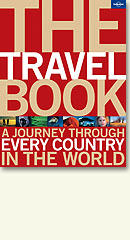
The Travel Book
A Journey Through Every Country In The World
Lonely Planet


"The World is a book and those who do not travel read only a page" - St. Augustine

If you are looking for a good gift this season especially for someone who is a world traveler then you may want to take a look at Lonely Planet's fascinating pictorial book. Recently published, it is titled "The Travel Book - A Journey Through Every Country In the World""

Consisting of 444 pages, 1200 images, 230 countries, and weighing nearly 4 lbs it is one complete and fascinating picture of our lonely planet.

As the flap jacket says - Ever since our first, faltering, upright steps, humankind has traveled. Everywhere is migration, exploration, pursuit. Terrible things have been caused by this restlessness, but it is also the source of much that is extraordinary and wonderful. This book seeks to inspire the right kind of travel in today's world, through a definitive expression of its promiscuous diversity and difference. The world is a breathtakingly big place, and this book has attempted to capture the spirit and magic of every single country. It shows the slice of life in every corner of the globe, and all points in between.

The world is viewed in a pleasing kind of egalitarianism- USA and UK get the same two pages with half a dozen pictures and a block of text as does Cote D'Ivoire and Togo. The book starts off in an A to Z format from Afghanistan, Albania, and Algeria and painstakingly works its way to Zambia and Zimbabwe. There is a sense of wonder as dramatically different countries follow each other. Belgium after Belarus, Martinique after Marshall Islands, Tuvalu after Turks & Caicos, Virgin Island after Vietnam. Countries are mysteriously handcuffed through history and heritage that now links their names through the English alphabet barely hiding a deeper connection shared by humans. The images are haunting - Gitaga dancers leaping in the air, volcanic plugs in Rumsiki, herders following a flock of sheep in Cotopaxi, donkeys picking their way down cobble steps on Santorini, and a bejeweled Bedouin girl smiling beneath a florid headscarf.

I flipped through the pages excitedly, stopping at some of the countries I had been to - Australia, Czech Republic, French Polynesia, Gambia, Israel, Malaysia, Mongolia, Vatican City.............and flagging the places I want to go to- Argentina, Bhutan, Dominican Republic, Iceland, Panama, Tibet, Turkey, Tuvalu, Vanauatu...........

Traveling with respect, curiosity, and a sense of humor is a satisfying and liberating pleasure. So travel more, travel well, travel safely. Wander around the planet or at least the pages of this book. Lose your way and find yourself some place else.

The books costs $US 39.99 but you can find it at Amazon for $23.99

Saturday, August 09, 2003

A Classroom on Top of the World


We paused to catch our breath and looked at the majestic sight in front of us. Mount Kangchenjunga, at 28,168 feet the third highest mountain on the planet, towered above us. The bright sunshine glistened off the icy slopes of this Himalayan skyscraper. A plume of mist rose from the top of the peak and was swiftly carried away by the ferocious wind. Suddenly the radio crackled to life: "We are on top of Go-Cha La pass and will start our descent shortly." The message was from five team members who had reached the high point of some 17,000 feet beneath the shear south face of Kangchenjunga. Cheers broke out among the remainder of our trekking party of eighteen.

Supported by a staff of Sherpas and porters and a herd of yak, Wharton Leadership Ventures had brought a group of MBA students and alumni and several participants from the Wharton Executive Education programs to the Indian state of Sikkim in the Eastern Himalayas. Now in its fifth year, our trek had earlier been slated to reach the lower slopes of Mount Everest in Nepal. But due to the sometimes violent unrest in Nepal this year, the trek had been redirected to the slopes around India's towering colossus of Kangchenjunga.

The trek's lofty goals were in keeping with the heights we were scaling. Leadership is a capacity that draws on all aspects of an individual and an organization. Developing a vision, articulating it, and inspiring others to achieve it require not only careful analysis and technical knowledge but also a sense for what is important for the organization and for the people in and around it. We knew that mastering these abilities is a lifelong endeavor, and this leadership trek promised an opportunity to continue our leadership development, exercise our body, cross-train our mind, and reflect on our leadership future amongst the awe-inspiring peaks of the Himalayas.

Teaching leadership in a classroom is challenging enough. But how on earth do you teach leadership by shifting the classroom to a remote mountain landscape reached only by days of international flights and treacherous road travel?

Our trek started at Yuksam, a tiny Himalayan village at a height of 6,800 feet, passed through dense pine and rhododendron forests to Alpine meadows above the tree line and finally to a point where there was no e-mail, no electricity, no plumbing, no human settlements, no plant or animal life -- just a vast cold emptiness on a glacial moraine with some of the most remote, desolate vistas I have ever seen.

Within hours of hitting the trail it was clear that our trekkers came with varied backgrounds and abilities. Lindsay Patrick, who had grown up in the Canadian Rockies and captained the Wharton women's soccer team, scampered up the steep slopes and slithered down snowy stretches like a mountain goat. I by contrast had grown up a few hundred miles north of the equator and had not seen snow till I was in my thirties.

Our second night's campsite was the windswept plateau of Dzongri at an altitude of 13,200 feet. Lynne Dant, a marketing manager for a specialty chemicals company, and Eric Byrne, a software consultant, were anxiously anticipated the evening as this would be the first time that they had ever camped in the great outdoors. They were shocked as we neared the campsite when we were hit with a fierce Himalayan ice storm that rattled even our experienced guides. The wind howled and thunder cracked all night and into the following day, blanketing our tents and the landscape with layers of hail and snow.

As the storm continued through another night, we began to face a critical decision: whether to stay put until the weather abated, or to push higher in the storm. The snow-covered trail ahead initially dropped more than 1,000 feet into a river gorge, and then back up the other side onto a treacherous boulder field. We had no idea how slippery and dangerous the descent and subsequent ascent would be. Some of us urged that we remain at Dzongri until the storm abated, while others were eager to go. Everybody weighed in with their opinions, and the collective will came to point toward climbing higher despite the conditions. This turned out to be an excellent decision, as the sun emerged several hours later to melt the new snow and reveal an array of spectacular peaks soaring above us.


Several nights later we readied for a 3 am departure for the high pass of Go-Cha La. Our trip physician, Brad Reinke, warned us to pay close attention to any signs of altitude sickness once we ascended over 15,000 feet. A trip leader added in no uncertain terms that while going up was voluntary, getting back was mandatory. As we climbed up, each of us had to continually assess how we felt, how much higher we could ascend, and how much reserve remained for getting back down. We knew that the latter would be critical not only for own well being but also for the safety and success of the entire team.


Most of the team made it to the Go-Cha La point at 16,700 feet, and five pushed all the way up to Go-Cha La pass at 17,000 feet. Lynn Dant and I had set our own personal "Go-Cha La" of reaching at least 16,000 feet, and we succeeded in climbing higher than that and getting a magnificent up close view of Kangchenjunga before our inner voices said that was enough. With our type A personalities it was hard to say "no" to going all the way to the top. But we had to make a sensible call to leave ourselves with enough reserves to descend safely and not jeopardize the rest of the team. It proved a personal leadership moment.

(Original article in the Wharton Leadership Digest. See the 5th article from the top)


Photos from the Himalayas